
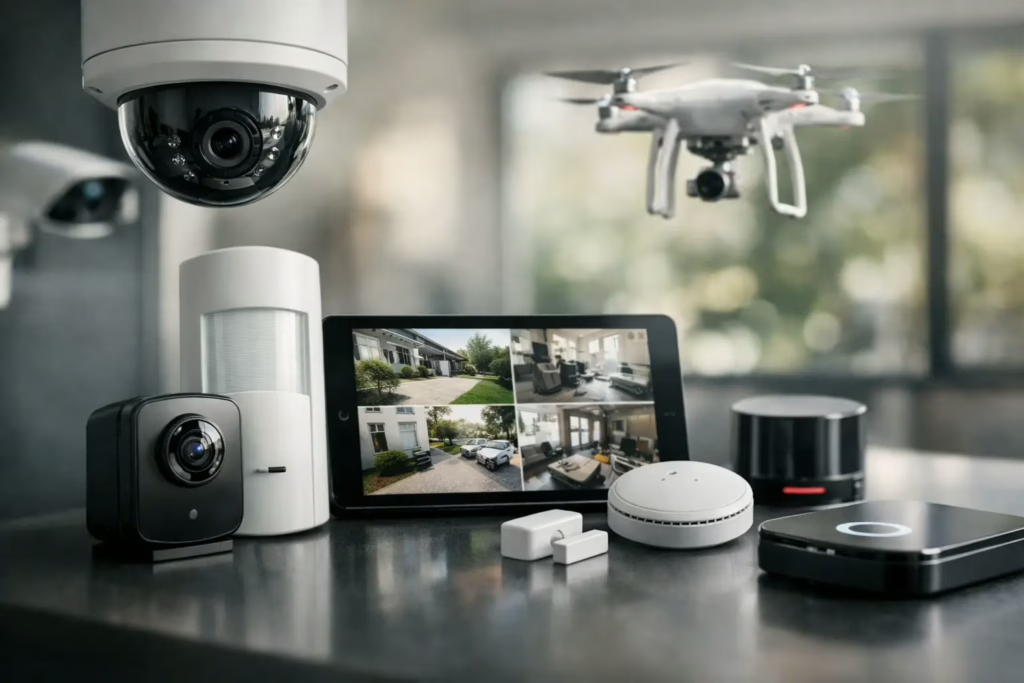
A radar hit without visual confirmation slows a decision. An RF alert without location data creates ambiguity. A camera feed without cueing wastes operator time. In high-risk environments, a multi sensor fusion security system matters because it turns partial signals into operational certainty and shortens the path from detection to action.
That distinction is not academic. It affects whether a drone incursion is classified in time, whether a perimeter breach is tracked across terrain transitions, and whether intervention is proportional, lawful and effective. For defence sites, critical infrastructure, custodial estates and high-security events, the question is no longer whether to deploy sensors. The question is whether those sensors operate as a coordinated system or as disconnected sources of friction.
What a multi sensor fusion security system actually does
At its core, a multi sensor fusion security system combines data from different sensing modalities into a single operational picture. In practice, that usually means radar, RF detection, electro-optical and infrared payloads, acoustic inputs, access control events, mapping layers and AI-supported analytics working inside one command framework.
The value is not the number of sensors on a site. It is the quality of correlation between them. A radar track may indicate movement at range, but radar alone may struggle with classification in cluttered environments. RF sensors may identify a drone control link or protocol signature, but not every threat emits consistently, and not every emitter is hostile. EO/IR can support classification and evidential clarity, but only if the system can cue the camera to the right area at the right time.
Fusion closes those gaps. It weighs confidence across multiple inputs, resolves contradictions where possible, and presents operators with a more reliable threat picture than any single sensor can provide on its own.
Why single-layer security fails under pressure
Single-sensor deployments tend to perform well in controlled demonstrations and less well in contested or complex environments. Urban clutter, weather, terrain masking, signal congestion and high target density all degrade isolated systems in different ways.
A camera-led security posture, for example, depends heavily on line of sight, lighting conditions and operator attention. A radar-led posture improves coverage and early warning, but can generate false tracks if the environment is poorly characterised. RF-led architectures are effective in many counter-UAS scenarios, yet they are vulnerable to low-emission or autonomous threat profiles.
The operational issue is not that any one of these technologies is weak. It is that every sensing method has a failure mode. In a live incident, those failure modes rarely appear one at a time. They stack. A fused system is designed around that reality.
The operational advantage of fused detection and tracking
The strongest security architectures reduce uncertainty at each stage of the kill chain or response chain. Detection must happen early enough to create options. Identification must be accurate enough to support lawful intervention. Tracking must persist as the threat moves, changes altitude, crosses sectors or mixes with background traffic.
This is where fusion changes outcomes. When radar initiates a track, EO/IR can be automatically slewed to the coordinates. When RF detects a likely drone controller, geolocation can be layered against air and ground tracks. When thermal imagery confirms movement after dark, the system can assign higher confidence to an otherwise ambiguous event. The operator sees one incident, not three disconnected alerts.
That compression of time is critical. High-risk operators do not need more notifications. They need fewer, better decisions delivered faster.
Sensor fusion in counter-UAS environments
Counter-UAS is one of the clearest examples of why integration matters. Small drones present a difficult target set because they are low, slow, small and often masked by environmental noise. No single sensor provides reliable coverage across all drone types, flight profiles and terrain conditions.
A fused architecture improves probability of detection and quality of response. Radar supports broad-area surveillance and initial tracking. RF contributes protocol awareness, pilot-location indicators and spectrum intelligence where emissions are present. EO/IR provides visual verification. Electronic warfare tools and effectors can then be matched to the confidence level and rules of engagement.
The gain is not only better detection. It is better intervention discipline. In a crowded or sensitive environment, the wrong response can create its own risk. Fusion supports proportionate action because it improves confidence before disruption or defeat measures are applied.
Beyond air threats
The same principle applies to ground perimeter security, maritime approaches and protected infrastructure. A fence alarm on its own may indicate intrusion, tampering or wildlife. A thermal track paired with access control anomalies and ground radar creates a very different operational picture. Likewise, a vessel approaching a restricted zone can be assessed more effectively when radar, AIS, optical feeds and geofenced behavioural analytics are aligned.
In each case, the system should help the operator understand intent, not just movement.
Integration matters more than hardware count
Procurement programmes often begin with a sensor inventory and end with a control-room problem. More devices are added, but operators still work across separate interfaces, separate maps and separate alert streams. That is not fusion. It is accumulation.
A capable multi sensor fusion security system depends on integration architecture. Data models must align. Time synchronisation must be reliable. Sensor confidence scoring must be transparent enough for operators to trust. Alert logic must be tuned to the mission, not left at factory defaults. Intervention tools must be connected to the same operational layer, with auditability and command authority preserved.
This is where integration becomes the real differentiator. Two sites may own similar hardware, yet one gains operational control while the other gains more screens. PREZIS is built around that distinction – orchestrating sensing, analytics, decision support and intervention into one mission-ready layer.
What buyers should assess before deployment
A sound procurement decision starts with environment and threat model, not product brochures. Terrain, spectrum density, weather patterns, airspace complexity, legal constraints and staffing models all affect what fusion should look like in practice.
Buyers should examine whether the system can correlate heterogeneous data in real time, whether cueing between sensors is automated, and whether the operator interface reduces workload rather than adding interpretation burden. It is also worth testing how the architecture performs under degraded conditions. What happens if GNSS is contested, if one sensor stream drops, or if multiple low-confidence events occur simultaneously?
Interoperability is another practical issue. Institutional users rarely have the luxury of a greenfield site. New fusion layers must work with existing CCTV, command-and-control environments, radio networks, incident workflows and reporting structures. A technically impressive platform that cannot integrate into the operational estate may create delay rather than advantage.
Trade-offs are real
Fusion improves performance, but it is not magic. More sensors can mean more complexity if the architecture is poorly engineered. False positives do not disappear automatically; they are managed through correlation logic, calibration and site-specific tuning. Latency can become a problem if data pipelines are not designed for operational speed. Maintenance discipline also matters, because a fused system is only as credible as the health of its inputs.
There is also a strategic trade-off between centralisation and resilience. A fully unified operating picture supports command speed, but the system should still degrade gracefully if one node or transport path is disrupted. For military and security-critical deployments, resilience is not a technical afterthought. It is part of the design requirement.
Where the strongest results usually come from
The best outcomes tend to come from layered deployments shaped around mission priorities. For a correctional facility, that may mean RF, radar and EO/IR aligned to low-altitude drone interdiction and perimeter anomalies. For an airport-adjacent critical site, it may mean careful deconfliction between legitimate traffic and hostile profiles. For a major public event, the focus may shift towards rapid deployment, mobile command visibility and tightly controlled intervention thresholds.
The common factor is not a fixed stack. It is a tailored architecture that turns sensing into control.
Security leaders are under pressure to make faster decisions with fewer blind spots and lower tolerance for collateral impact. A multi sensor fusion security system addresses that pressure when it is designed as an operational architecture rather than a bundle of devices. The real test is simple: when the first alert lands, does the system give your team another data point, or does it give them a decision advantage?