
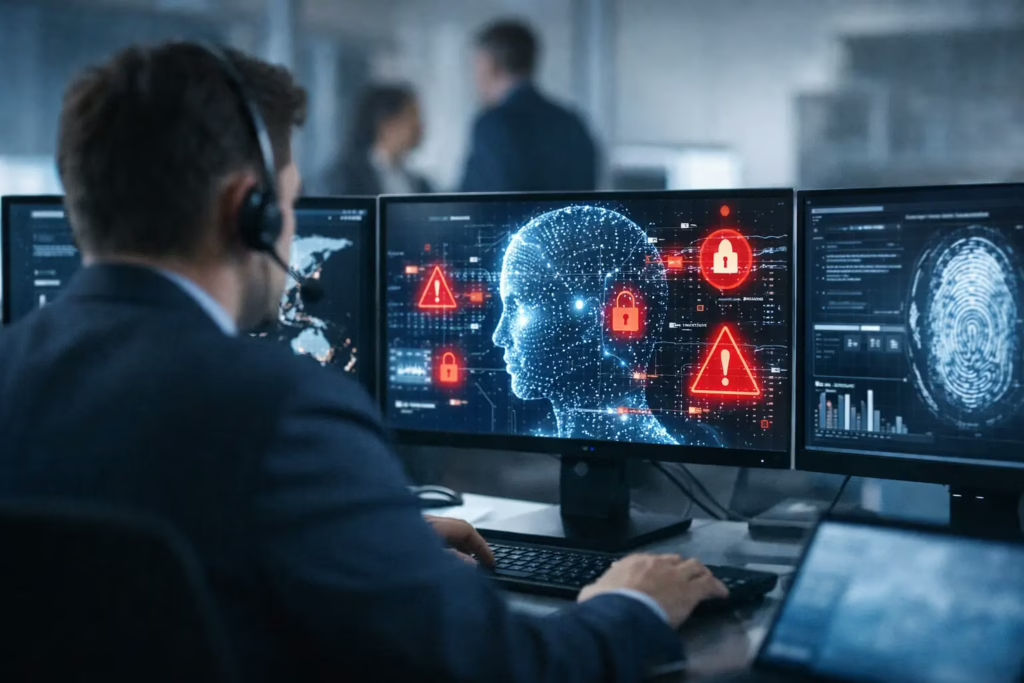
A radar track appears for three seconds, drops behind clutter, then returns with a flight profile that does not match any authorised pattern. At that point, an ai threat detection platform is either a decisive operational asset or just another screen producing noise. In high-risk environments, the distinction is not academic. It determines whether operators gain time, confidence and control, or lose all three at once.
For defence, critical infrastructure, corrections and high-security events, the term is often used too loosely. Many systems claim AI-enabled detection because they apply basic classification models to isolated sensor feeds. That is not enough. A credible platform must function as part of an operational architecture that fuses sensing, identification, prioritisation and response. If it cannot convert fragmented data into a coherent decision pathway, it does not reduce risk. It simply shifts the burden back to the operator.
What an AI threat detection platform actually is
At its core, an AI threat detection platform is a software-led decision layer that ingests multiple data sources, analyses patterns at machine speed and surfaces actionable alerts. In security terms, that means more than spotting anomalies. It means determining what matters, what can wait, and what requires immediate intervention.
The strongest platforms are not built around a single sensor or single algorithm. They correlate radar, RF, electro-optical, infrared, acoustic and networked intelligence inputs, then assess behaviour against the operational context. A low, slow track near a power site during poor visibility presents a different problem from the same track in a permissive training area. AI has to understand enough of the mission environment to support judgement, not bypass it.
That is why integration matters more than model sophistication in isolation. A highly accurate classifier still fails operationally if its outputs do not align with command interfaces, electronic warfare tools, effectors or reporting chains. Detection without orchestration is incomplete.
Why isolated AI detection tools fall short
Security buyers rarely struggle to find detection technologies. The harder problem is managing the hand-offs between them. One system identifies a potential drone. Another validates the signal. A third displays the track. A fourth supports mitigation. By the time information has passed through separate consoles and separate teams, the engagement window may already be closing.
This is where many deployments underperform. They add technical capability but increase cognitive load. Operators must reconcile conflicting alerts, manage different confidence thresholds and work across fragmented interfaces. In calm conditions that is inefficient. In compressed timelines it becomes a liability.
An effective ai threat detection platform reduces this friction. It establishes a common operational picture, applies machine-led triage and presents response options in a usable format. That does not mean replacing trained personnel. It means giving them a cleaner path from observation to decision.
The trade-off is straightforward. Greater automation can improve speed, but only if confidence scoring, auditability and human control are built in. In regulated or mission-sensitive environments, a black-box recommendation engine is rarely acceptable. Security leaders need to know why a threat was prioritised, which sensor inputs drove the assessment and what level of certainty supports the recommendation.
The operational requirements that matter most
An ai threat detection platform should be judged by operational performance, not by marketing claims around algorithm count or raw data throughput. The first test is fusion quality. Can the platform reconcile noisy, partial and sometimes contradictory inputs into a track or event picture that an operator can trust?
The second is speed. Detection latency matters, but decision latency matters more. A system that classifies quickly yet slows the route to intervention has not solved the real problem. In counter-UAS and spectrum-contested scenarios, seconds are often the margin between controlled mitigation and uncontrolled escalation.
The third is adaptability. Threat libraries age quickly. Adversaries alter routes, signatures, timings and emitters. Platforms need retraining pathways, rule updates and environment-specific tuning without forcing a full redesign. Static logic in a dynamic threat environment creates false assurance.
The fourth is interoperability. Military, homeland security and infrastructure operators do not buy technology in a vacuum. They inherit legacy sensors, command systems, policy constraints and procurement realities. A platform that performs well only in a clean, closed stack is of limited value. The more relevant question is whether it can sit over mixed infrastructure and still produce coherent operational outputs.
AI threat detection platform design for high-risk environments
High-risk environments punish systems that were designed for demos rather than deployment. Weather degrades optics. Urban clutter complicates RF interpretation. Legitimate traffic creates background noise. Human operators rotate, fatigue accumulates and communications paths are not always perfect. Under those conditions, the platform design has to account for friction from the outset.
That starts with disciplined sensor layering. No single modality is sufficient across all scenarios. Radar may provide range and movement. RF may indicate control links or protocol behaviours. EO and IR add visual confirmation. Acoustic inputs can help in constrained spaces. AI should not treat these as separate channels to be reviewed one by one. It should weight and correlate them according to environmental conditions and mission priorities.
It also requires threshold management. Aggressive sensitivity may catch more edge cases, but it can also swamp teams with false positives. Conservative thresholds may protect attention, but they risk missing low-signature threats. The right balance depends on the site, the rules of engagement and the tolerance for nuisance alerts versus missed detections. There is no universal setting that works everywhere.
For that reason, mature deployments are tailored rather than generic. A prison, an airbase, a refinery and a high-security public event each present different terrain, legal constraints and response requirements. The platform should reflect that operational reality.
From detection to action is the real benchmark
Threat detection is only valuable if it compresses the timeline to action. In practice, that means the platform must support decision-support workflows, not merely provide awareness. It should present prioritised tracks, confidence levels, likely threat categories and recommended response paths aligned to the available intervention options.
In some environments the correct next step is observation and evidence capture. In others it may be electronic disruption, controlled interdiction or cueing to a kinetic layer. The platform should not assume one response model. It should support the response architecture already defined by the operator and the governing authority.
This is where integrated system design becomes decisive. When sensing, analytics and intervention sit inside a coordinated operational layer, operators can move with clarity. When those capabilities remain disconnected, every alert becomes a manual coordination exercise.
For organisations facing low-altitude air threats, contested spectrum activity or rapid perimeter incursions, speed is not simply a convenience metric. It is the core operational currency. PREZIS approaches this problem through integrated architectures that shorten the route from detection to decision and from decision to controlled effect.
Procurement questions worth asking before selection
Before selecting any platform, institutional buyers should test the claims that matter most in field conditions. Ask how the system performs with degraded inputs, not ideal ones. Ask whether confidence scoring is explainable to operators and acceptable to oversight bodies. Ask what data is required for retraining, how quickly new threat behaviours can be incorporated, and how the platform handles contested or denied communications.
It is also worth asking who carries the integration burden. Many vendors sell software as though connection to sensors, command systems and effectors is a secondary implementation detail. It is not. Integration defines whether the platform becomes a force multiplier or another isolated component that must be managed around.
Finally, assess operator usability with the same seriousness as model performance. A system may achieve impressive technical scores and still fail in live operations if the interface is cluttered, the alerts are ambiguous or the workflow does not match command practice. In security environments, elegant engineering that ignores operational behaviour rarely holds up.
The market will continue to produce more AI-labelled products, and some will be useful in narrow roles. But buyers responsible for real-world protection should set a higher threshold. The right ai threat detection platform is not a dashboard with machine learning attached. It is a decision-grade operational layer that fuses inputs, clarifies risk and supports timely intervention under pressure.
That is the standard worth applying, because the environments that need these systems most do not reward technical novelty on its own. They reward control, speed and decisions that stand up when the window to act is measured in seconds.