
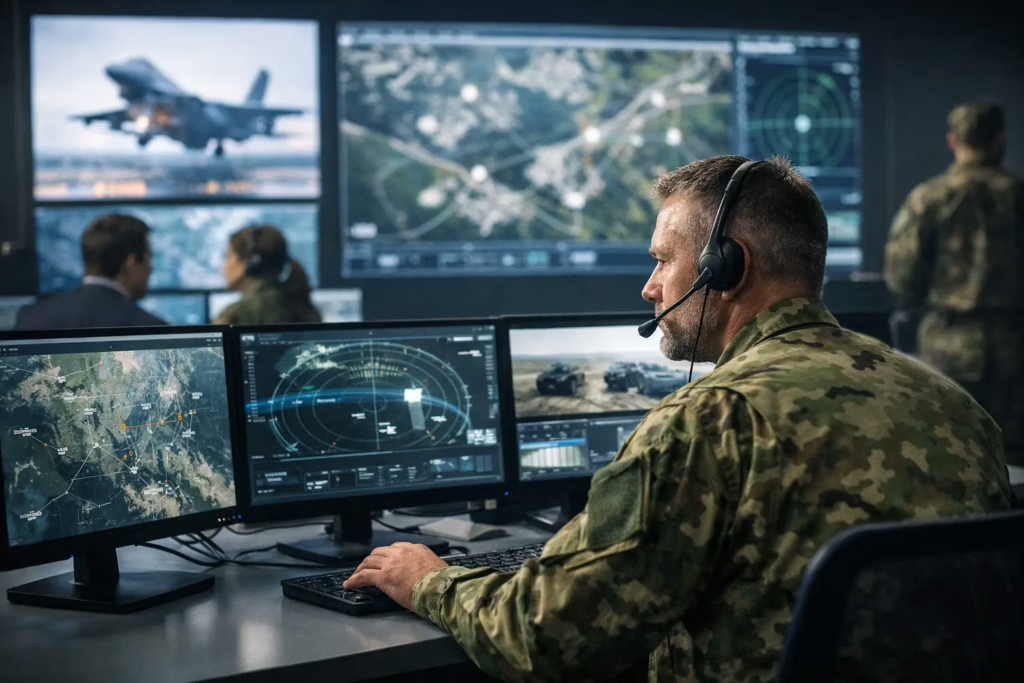
A drone appears over a refinery perimeter at 02:13. Radar tracks it, RF sensing flags a probable control link, EO confirms payload risk, and the operations room has seconds to decide whether to monitor, jam, isolate airspace, or escalate to kinetic response. That is where decision support system defence stops being a software label and becomes an operational requirement.
In high-risk environments, the problem is rarely a lack of data. The problem is too much data arriving from too many systems, each with its own interface, alert logic and confidence score. Operators do not need another dashboard. They need a decision layer that fuses inputs, ranks threats, presents viable response options and shortens the interval between detection and action without creating avoidable collateral effects.
What decision support system defence actually means
In defence and security settings, a decision support system is not a passive reporting tool. It is an operational layer designed to assist command teams and frontline operators in time-sensitive conditions. It ingests data from multiple sources, applies rules, analytics and contextual logic, and delivers recommendations that support faster and more controlled action.
The defence context matters. A hospital may use decision support to improve scheduling. A military base, prison or energy site uses it to assess hostile intent, deconflict response measures and maintain command authority under pressure. The standard is therefore higher. Accuracy matters, but so do explainability, latency, resilience, permissions, escalation pathways and legal constraints.
A capable decision support system defence architecture typically sits between sensing and intervention. It receives inputs from radar, radio frequency detection, EO/IR, access control, acoustic sensors, cyber telemetry and intelligence feeds. It then correlates those inputs into a usable operational picture rather than leaving personnel to mentally fuse fragmented alerts.
Why fragmented systems fail in live operations
Most security estates have grown in layers. One contractor deploys radar. Another installs cameras. A third supplies analytics. Counter-UAS, electronic warfare, perimeter management and command software are often procured separately and connected only loosely, if at all. On paper, every component performs. In a live incident, the gaps appear.
The first gap is time. Operators lose seconds moving between screens, confirming whether multiple alerts refer to one object or several, and checking whether a proposed response will interfere with friendly systems. The second gap is confidence. If the platform cannot show why it classifies a target as hostile or why it recommends a particular intervention, human teams hesitate. The third gap is control. Without an integrated logic layer, escalation can become inconsistent across shifts, sites or jurisdictions.
This is why integration is central. Decision quality depends on the system’s ability to present one operational truth from many imperfect inputs. It also depends on keeping the operator in command rather than burying judgement under automation.
The core functions of a decision support system defence platform
A credible platform does four jobs well. First, it fuses data across domains. Sensor correlation is the starting point, because isolated alerts do not support reliable action. A drone track, for example, becomes far more useful when its flight path, RF signature, visual confirmation, geofencing breach and local airspace rules are assessed together.
Second, it prioritises. In complex environments, there may be dozens of anomalies but only one true threat. The system must rank events by risk, proximity, intent indicators, protected asset value and likely consequence. That reduces operator overload and helps command staff allocate resources where they matter most.
Third, it recommends response pathways. This does not mean replacing the chain of command. It means presenting the most relevant options based on rules of engagement, site policy, available effectors, environmental conditions and the likely impact of intervention. A prison, for instance, may prioritise interdiction methods that minimise interference with surrounding civilian communications. A military site may accept different trade-offs.
Fourth, it records and learns. Every alert, classification, operator action and outcome should feed post-incident review. Over time, this improves threat models, operating procedures and sensor tuning. It also strengthens auditability, which matters in regulated and politically sensitive environments.
Decision support system defence in Counter-UAS operations
Counter-UAS is one of the clearest use cases because the timeline is compressed and the variables shift quickly. A single drone can be benign, negligent or hostile. A swarm can be surveillance, smuggling, disruption or precursor activity. Response cannot rely on one sensor or one rule.
An effective decision support layer assesses track behaviour, launch point probability, payload indicators, RF conditions, no-fly policy, nearby infrastructure and available mitigations. It helps operators answer the key operational question: what action is justified now, and what downstream effects will that action create?
That distinction is critical. Jamming may neutralise one threat while degrading friendly communications. A kinetic option may stop the platform but create ground hazard. Observation may preserve evidence but expose the site to unnecessary risk. Good decision support does not present response as a binary choice. It presents consequence-aware options.
For this reason, Counter-UAS deployments benefit most when sensing, identification, decision support and intervention sit inside one architecture. PREZIS builds around that principle because the operational advantage is not a single detector or effector. It is the ability to orchestrate the full chain under one command logic.
The trade-offs that buyers should examine
Not every decision support platform is suited to defence-grade use. Some systems are strong on visualisation but weak on interoperability. Others promise AI-led insight but cannot explain why they generated a recommendation. In procurement terms, that creates risk.
The first trade-off is automation versus human control. More automation can reduce workload, but over-automation can weaken trust and create liability if recommendations cannot be challenged or understood. In most high-stakes settings, the better model is assisted decision-making with clear escalation thresholds.
The second trade-off is breadth versus depth. A broad platform may ingest many data sources yet offer shallow domain logic. A narrower system may perform extremely well in one mission set, such as Counter-UAS, but struggle to support wider site security operations. The right answer depends on whether the buyer is solving a discrete threat problem or building a long-term operational architecture.
The third trade-off is speed versus certainty. Fast classification is valuable only if confidence levels are visible and sensible. In some cases, a provisional alert with transparent confidence scoring is better than a delayed but overconfident recommendation. Operational teams need to understand uncertainty, not have it hidden.
Where decision support delivers measurable value
The strongest outcomes usually appear in environments where multiple security functions already exist but are not yet orchestrated. Critical infrastructure sites gain from reduced time to verify and intervene around air, perimeter and spectrum threats. Correctional facilities benefit when drone detection, inmate intelligence and response protocols are brought into one operating picture. High-security events gain from a tighter control loop where temporary systems, public safety coordination and restricted airspace management need to function as one.
Military and homeland security users often see the value even earlier because the mission cost of delay is so high. A fused decision layer improves tempo, but it also improves consistency. Teams across shifts and locations respond through the same operational logic, with site-specific rules built in. That matters when incidents trigger scrutiny after the fact.
What to ask before deployment
A serious procurement process should test more than feature lists. Buyers should ask how the platform handles degraded communications, disputed sensor inputs and false positives in dense environments. They should ask whether response recommendations are explainable, whether the interface supports rapid action under stress, and whether the system can integrate with existing command, EW and effector assets without expensive redesign.
They should also test doctrine fit. A system may be technically impressive and still unsuited to the user’s legal authorities, staffing model or rules of engagement. Decision support only works when the software logic, the operating procedure and the command structure align.
The strongest deployments are therefore tailored, not generic. They account for terrain, threat profile, protected asset class and intervention constraints from the start.
Decision support in defence is ultimately about compressing time without compressing judgement. The right system helps operators act earlier, with better evidence and tighter control, while preserving accountability at every step. In environments where seconds carry strategic weight, that is not a software enhancement. It is part of the defensive architecture itself.