
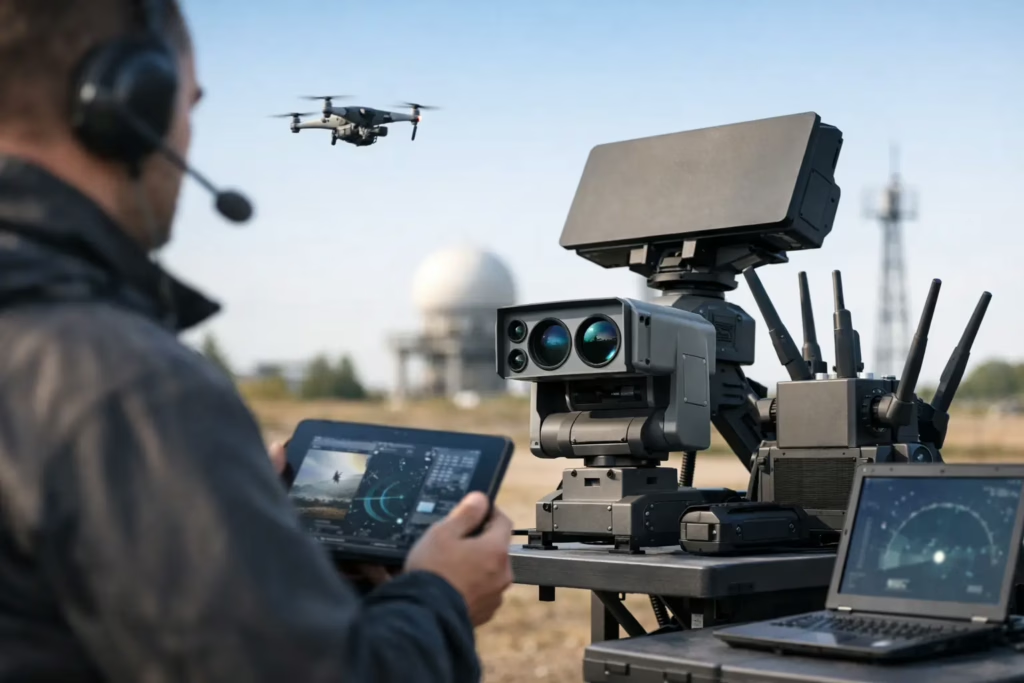
A Counter-UAS purchase rarely fails on the specification sheet. It fails in the gap between what the system can demonstrate in isolation and what operators need it to do under pressure, in cluttered airspace, under legal constraint, and with limited time to act. That is the real context for how to evaluate counter UAS capability: not as a hardware comparison, but as an operational decision about sensing, judgement, intervention, and command.
For defence organisations, critical infrastructure operators, correctional estates, and planners of high-security events, the central question is not which sensor has the longest range or which effector appears most advanced. The question is whether the full architecture can reduce the timeline from detection to action with enough confidence to support a lawful, proportionate, and effective response.
Start with the mission, not the product
The strongest evaluations begin with the threat environment. A prison, an airport-adjacent facility, a border zone, and a temporary event site do not face the same drone problem. The aircraft types differ, the radio-frequency environment differs, the acceptable intervention methods differ, and the cost of a false positive differs.
That sounds obvious, yet many assessments still start with vendor categories such as radar, RF detection, jamming, or kinetic intercept. That approach creates fragmented buying decisions. A better method defines the mission first: detect unauthorised UAS activity, classify intent, track flight path, confirm threat relevance, and apply the right response with minimal disruption.
This is where many buyers first see the importance of integration. A technically strong sensor that cannot pass reliable data into command workflows may slow operations rather than improve them. Equally, a powerful defeat option is of limited value if identification confidence is poor or if authorisation takes too long.
How to evaluate counter UAS against real operational requirements
To evaluate properly, frame the system against a chain of operational outcomes. Can it detect early enough? Can it classify accurately enough? Can it maintain track continuity? Can it present decision-ready information to an operator or command layer? Can it intervene effectively inside the legal and physical constraints of the site?
Each stage matters because Counter-UAS is cumulative. Weakness at one point propagates into the next. Long-range detection without useful classification creates noise. Strong classification without track stability creates hesitation. Reliable sensing without an appropriate intervention option leaves the mission incomplete.
The practical implication is simple: score systems as architectures, not as components.
Assess sensing performance in layers
No single sensor modality performs best in every environment. Radar can offer broad-area awareness but may struggle with small, slow, low-signature targets in heavy clutter. RF detection can be highly effective against commercially controlled drones but has limitations against autonomous or radio-silent platforms. Electro-optical and thermal systems provide confirmation, but usually after cueing and often with weather, line-of-sight, or operator limitations.
A credible evaluation looks at how these layers complement one another. Buyers should examine detection range, but also revisit rate, coverage gaps, geolocation precision, classification confidence, and performance degradation in dense urban terrain, industrial electromagnetic clutter, or poor visibility.
Field testing matters more than brochure metrics. A system that performs well on a clean range may produce very different outputs near utilities, transport infrastructure, metal-rich compounds, or crowded events. The quality of data fusion also deserves scrutiny. If multiple sensors detect the same target, does the platform correlate that into one coherent track, or does it create duplicated alerts that increase operator burden?
Identification is where operational confidence is built
Detection alone is not enough. Decision-makers need to know whether they are seeing a genuine threat, an authorised drone, a bird, or environmental clutter. In most operational settings, the cost of misidentification is high. It may lead to delayed action, unnecessary disruption, or intervention against a non-threat.
This is why evaluation should focus on confidence thresholds, not just raw detection events. Ask how the system handles identification, friend-or-foe logic, drone library updates, protocol recognition, and visual confirmation workflows. Examine whether the interface presents uncertainty clearly or masks it behind simplified labels.
There is also a trade-off here. Systems tuned for maximum sensitivity may generate more detections but also more nuisance alerts. Systems tuned too conservatively may miss early indicators. The right balance depends on site risk, staffing model, and rules of engagement.
Evaluate the decision layer, not just the sensor layer
In high-stakes environments, time is lost less often in sensing than in command friction. Operators may need to verify the alert, understand airspace context, request authority, choose an effector, and coordinate with adjacent security or public safety functions. If the Counter-UAS platform does not support that flow, the response window narrows quickly.
A serious evaluation therefore includes the operator interface, alert logic, incident management, audit trail, and interoperability with wider command-and-control systems. Can the platform ingest external data such as air picture inputs, access control events, or perimeter alarms? Can it prioritise tracks based on behaviour and protected zones? Can it present recommended actions without removing human control?
This is often the decisive difference between a collection of tools and a mission-ready capability. PREZIS operates in this integration space because operational value is created when sensing, analysis, and intervention function as one decision architecture rather than separate technical islands.
Intervention capability must be lawful, proportionate, and precise
When buyers compare defeat options, they should avoid the trap of asking only what can stop a drone. The more relevant question is what can stop the right drone, in the right place, with acceptable collateral impact.
Electronic attack can be effective, but it is highly dependent on spectrum conditions, target behaviours, regulatory permissions, and nearby systems that must remain unaffected. GNSS disruption or command-link interference may be unacceptable near certain infrastructure or public environments. Kinetic options may offer certainty in some scenarios but create clear safety and debris considerations. Takeover capabilities can be attractive where recoverability matters, yet they are not universally effective against all target types.
So when evaluating intervention, examine precision, response time, environmental constraints, operator workload, safety envelopes, and legal authority. A technically capable effector that cannot be employed under local policy is not an operational solution.
Test interoperability under pressure
A Counter-UAS system rarely operates alone. It has to sit within a broader security estate that may include surveillance, access control, communications, EW assets, intelligence feeds, and incident command processes. Procurement teams should assess how readily the candidate solution exchanges data, supports open interfaces, and scales across sites or mission sets.
Interoperability is not a secondary feature. It shapes resilience, upgrade paths, and long-term cost. A closed system may appear efficient at first, but it can become restrictive when threat patterns change, when new effectors are required, or when command structures evolve.
This is one area where lab demonstrations can be misleading. Ask for evidence of integration under realistic operating conditions, with real operator workflows and realistic communications loads. The issue is not whether an API exists. The issue is whether the system continues to perform when multiple inputs, alerts, and commands are moving at operational tempo.
Use scenarios that expose trade-offs
The best evaluations are scenario-led. A prison should test low, short-duration flights delivering contraband near perimeter blind spots. A critical infrastructure site should test approaches over complex background clutter and near sensitive emitters. A high-security event should test congested RF conditions, temporary deployment constraints, and rapidly changing crowd geometry.
Scenario testing reveals trade-offs that paper evaluations miss. A highly sensitive system may overload a small team during an event. A fixed architecture may protect a static asset well but prove too rigid for mobile or temporary missions. A strong defeat option may be unusable once non-participants enter the area.
That is why procurement teams should define success in operational terms before trials begin. Measure time to detect, time to classify, time to decision, intervention effectiveness, false alert rate, and operator burden. Those metrics are far more useful than isolated maximum-range claims.
Consider sustainment from the outset
Counter-UAS capability is not a one-off purchase. Threat signatures evolve, firmware changes, drone protocols adapt, and site conditions shift. Evaluation should therefore include training demand, software update processes, maintenance requirements, cyber security posture, and the vendor’s ability to support configuration changes over time.
This is especially relevant for institutional buyers managing multiple locations or layered command structures. A system that needs heavy specialist support for routine changes may become difficult to sustain. By contrast, a system with disciplined configuration management, clear training pathways, and strong update governance will retain value far longer.
There is no universal answer to how to evaluate counter UAS because the right architecture depends on mission profile, legal framework, terrain, and risk appetite. But there is a disciplined approach: assess the full chain from sensing to action, test under realistic conditions, and judge performance as an integrated operational capability rather than a stack of disconnected features.
If the system helps operators make faster, more accurate decisions with lower collateral impact, it is moving in the right direction. If it adds noise, complexity, or legal friction, no specification sheet will rescue it. The most effective Counter-UAS investments are the ones that hold together when the environment is crowded, the timeline is short, and the decision has to be right.