
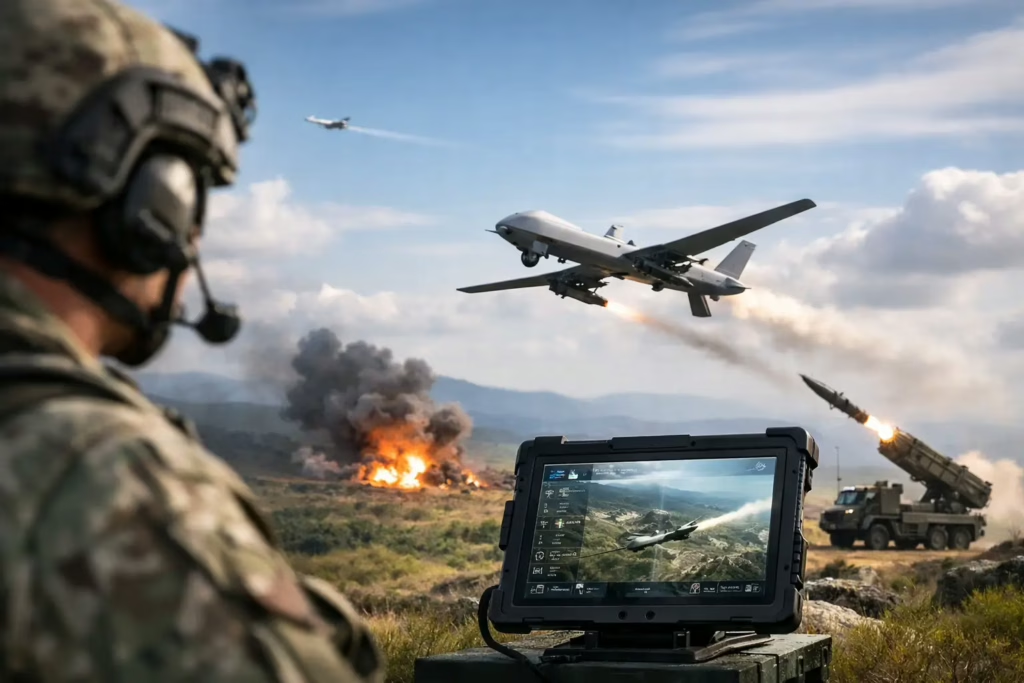
A target appears for seconds, not minutes. The sensor sees it, an operator classifies it, legal and operational constraints are checked, a firing solution is built, and an effect is delivered. If any link in that chain is isolated, the opportunity is lost. That is why precision strike integration matters. It is not a procurement label for pairing a weapon with a platform. It is the disciplined integration of sensing, identification, decision-support, communications and effectors into one operational process built for speed, control and discrimination.
For institutional buyers, the central question is not whether a strike asset is precise on paper. The question is whether the entire system can produce precision under operational pressure. Precision is created upstream as much as it is at the point of impact. It depends on sensor quality, data fusion, confidence scoring, battle management logic, rules of engagement, spectrum conditions, and the usability of the operator interface. A highly capable effector connected to fragmented inputs still delivers fragmented outcomes.
What precision strike integration actually means
In operational terms, precision strike integration is the alignment of five functions into a single mission architecture. The system must detect, identify, decide, assign and act. Each function has to support the next without adding avoidable latency or uncertainty.
Detection starts the chain, but raw detection is not enough. Modern environments produce clutter, decoys, interference and false positives. Integration therefore has to fuse radar, electro-optical, infrared, passive RF and other sources into a coherent track picture. That track picture must then move into identification and intent assessment. A contact is only actionable if the system can establish sufficient confidence in what it is, what it is doing, and whether intervention is proportionate and authorised.
Decision-support is where many architectures still fail. Too often, information is collected faster than it can be converted into action. Effective integration reduces cognitive load rather than increasing it. It should present operators and command elements with prioritised options, clear confidence levels, collateral risk indicators and recommended effect pathways. The objective is not to remove human control. The objective is to make human control faster and better informed.
The final step is the assignment of effect. That may be kinetic, electronic or a layered sequence of both. In many scenarios, the most precise outcome is not a strike in the conventional sense. It may be jamming, protocol disruption, navigation denial or another non-kinetic intervention that neutralises the threat while limiting physical damage. Precision, in other words, is a matter of operational effect, not simply warhead accuracy.
Why precision strike integration fails in the field
Most failure points are architectural rather than mechanical. Organisations often acquire best-of-breed components and assume interoperability will follow. In practice, it rarely does. Sensors speak in different data formats, command systems apply different logic, latency accumulates across middleware layers, and operator workflows are forced to bridge the gaps manually.
That matters because timing is decisive. In fast-moving tactical scenarios, ten seconds of delay can invalidate the track, change the geometry, or raise the collateral risk above an acceptable threshold. The problem is not only speed. It is confidence. If the operator cannot trust the fused picture, they will hesitate or request further confirmation. That may be prudent, but it also means the system has failed to deliver usable precision at the moment it was needed.
There is also a trade-off between automation and control. More automation can accelerate the chain, but excessive automation without transparent logic can create legal, ethical and operational problems. Institutional users do not need a black box. They need an architecture where machine assistance is explainable, thresholds are configurable, and decision authority remains aligned with mission policy. Good integration respects that reality.
The operational layers that matter most
A credible precision strike architecture is built in layers, and each layer must contribute to the same outcome. The sensing layer provides coverage, track continuity and target fidelity. The analytics layer turns sensor inputs into assessed threats with confidence values. The command layer applies policy, priorities and approval logic. The intervention layer selects and executes the most appropriate effect.
The interaction between these layers is where performance is won or lost. For example, if an RF detection system identifies a likely drone controller but the electro-optical feed cannot maintain visual confirmation, the architecture should not force operators to reconcile those threads by hand. It should maintain a common operational picture, show uncertainty clearly, and support action based on pre-defined confidence thresholds. That is especially important in Counter-UAS, where the engagement window is often brief and the consequence of a wrong intervention can be significant.
Electronic warfare adds another level of complexity. In contested spectrum conditions, the system must operate through interference, denial attempts and degraded communications. Precision strike integration therefore cannot be designed for ideal environments. It has to maintain functionality when links are unstable, GPS is unreliable, and adversaries are actively trying to confuse the sensor and command chain.
Precision strike integration in real deployment environments
The architecture required for a defence installation is not identical to the one required for a prison, an energy site or a high-security event. The principle remains the same, but the constraints differ.
In military and border environments, range, mobility and survivability may dominate design choices. The system has to support distributed sensing, mobile command nodes and multiple intervention options across changing terrain and threat vectors. In that setting, integration is as much about resilience as speed.
At critical infrastructure sites, the challenge is often discrimination in dense operational environments. There may be legitimate air traffic, nearby communications activity, and strict collateral constraints around industrial processes or public areas. Precision here means filtering noise, preserving operator confidence and selecting the least disruptive intervention that still neutralises the threat.
In correctional facilities and protected events, the issue is compressed geography. Threats can emerge close to sensitive boundaries, with limited time for verification and response. A useful architecture must therefore compress detection-to-action timelines without eroding oversight. This is where integrated operator workflows matter. If the user interface is cluttered or the approval chain is poorly structured, the technical performance of the underlying systems becomes irrelevant.
What buyers should evaluate before procurement
The right question is not whether a vendor offers precision strike capabilities. The right question is whether the proposed architecture can sustain precision across the entire operational chain. Buyers should look closely at data fusion quality, latency under load, auditability of decision-support logic, interoperability with existing command systems, and the practicality of operator workflows.
They should also test degraded-mode performance. Many demonstrations are built around clean conditions, full connectivity and ideal target behaviour. Real operations are not like that. Systems should be evaluated under RF congestion, partial sensor loss, ambiguous tracks and shifting rules of engagement. If precision depends on perfect conditions, it is not operational precision.
Another point is scalability. A local deployment may begin with one threat set and a limited intervention toolkit, but the architecture should be able to absorb new sensors, analytics modules and effectors without major redesign. That is where an integration-led partner has an advantage. The core value sits in the operational layer that orchestrates the system, not in any single device.
PREZIS approaches this problem from that systems level. The objective is not to present isolated components as answers, but to build an environment-specific architecture that reduces time from detection to action while preserving accuracy and command control.
The strategic value of integrated precision
Precision strike integration is not only a tactical capability. It is a strategic one. It affects deterrence, resource allocation, legal defensibility and mission tempo. An organisation that can identify threats accurately, choose proportionate effects quickly and document the decision chain clearly is in a stronger position across all four.
It also reduces waste. Poor integration leads to duplicated sensors, unnecessary operator burden, conservative delays and avoidable interventions. Strong integration sharpens the whole system. It helps scarce personnel act with greater confidence, supports better escalation management, and limits collateral impact by making the chosen effect more appropriate to the actual threat.
That is the point worth keeping in view. Precision does not begin at launch. It begins in the architecture. When sensing, analytics, command logic and intervention are integrated properly, the system does more than strike accurately. It creates the conditions for faster, cleaner and more defensible action when timing leaves no room for error.