
A drone appears over a refinery perimeter at 02:13. One sensor flags it as clutter. Another classifies it as a likely quadcopter. A third system records RF activity but does not pass that data to the operator console controlling the response layer. The problem is not a lack of equipment. It is a lack of orchestration. That is where multi domain defence integration changes the outcome.
For organisations operating in contested or high-risk environments, the operational gap is rarely detection alone. It is the delay between sensing, identification, decision and intervention. When those functions sit inside separate vendor stacks, every hand-off adds friction. In practical terms, that means slower response, lower confidence and a greater chance of either missing the threat or acting with poor precision.
Why multi domain defence integration matters now
Threat activity has become faster, cheaper and more distributed. Small unmanned systems, low-signature incursions, electronic interference and mixed-mode attacks do not respect traditional capability boundaries. A hostile drone can be a surveillance asset, a delivery platform, a decoy or the first element in a broader disruption campaign. The defensive response cannot be built around one device or one domain.
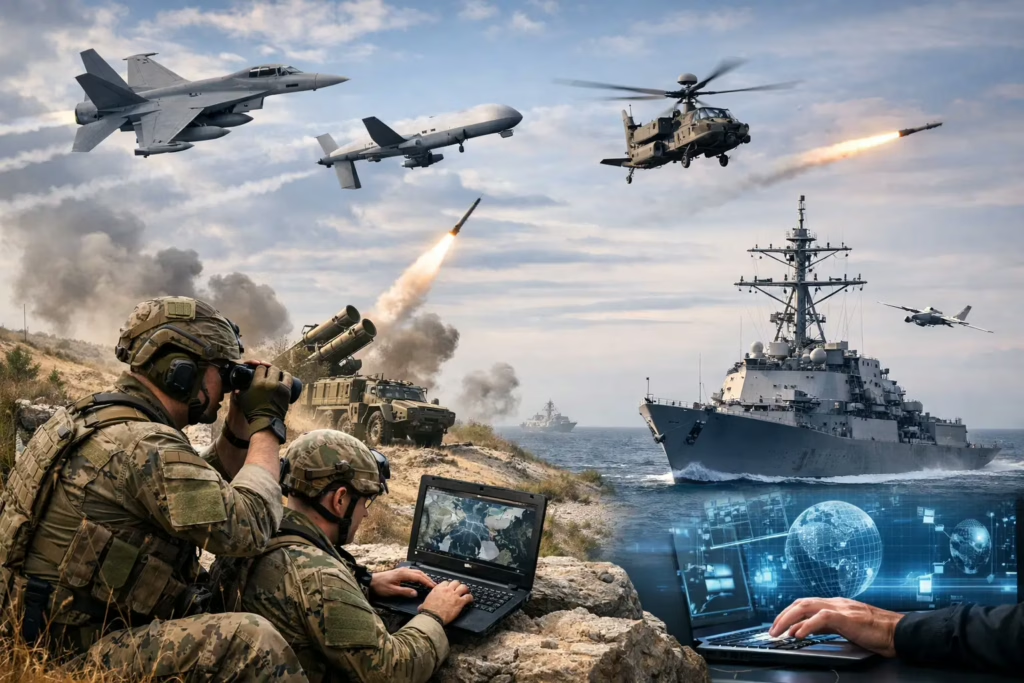
Multi domain defence integration brings radar, RF detection, electro-optical tracking, acoustic sensing, electronic warfare, AI-assisted analytics, command interfaces and intervention tools into a single operational architecture. The value is not theoretical. It is measured in reduced decision time, cleaner tracks, stronger operator confidence and tighter control of collateral impact.
This matters particularly for defence estates, critical infrastructure, correctional environments and protected events. In each case, the operational requirement is the same – see earlier, classify faster, decide with confidence and intervene with precision. A collection of capable products may appear strong on paper. In the field, disconnected systems create blind spots at the exact moment speed matters most.
Multi domain defence integration is an architecture problem
Too many procurement programmes still treat security capability as a sequence of product decisions. One team acquires sensors. Another selects analytics. A separate workstream sources jamming or kinetic response. Each element may perform well in isolation. The combined result often does not.
The reason is straightforward. Threat response is a chain, not a set of independent actions. Detection without accurate cueing wastes operator attention. Identification without contextual data increases false positives. Intervention without shared track quality raises legal, safety and mission risk. Integration is what converts these discrete functions into an operational system.
A properly integrated architecture creates a common operational layer across the full kill chain. Sensor inputs are correlated in real time. Classification models are informed by more than one data source. Operator interfaces are designed around action, not data overload. Effectors receive validated target information rather than fragmented feeds. The architecture does not merely display information. It compresses the path from awareness to control.
That distinction becomes critical in multi-threat settings. Consider a military site dealing with low, slow and small UAS activity while also managing spectrum congestion and legitimate airspace movement. A single-domain tool may detect one aspect of the problem. An integrated system can resolve the pattern, prioritise the track and support the least disruptive response option available.
Where fragmented systems fail
The weakness of fragmented security stacks is rarely visible during demonstrations. It appears under pressure. Data arrives out of sequence. Interfaces demand manual correlation. Operators shift between screens. Teams lose confidence in track continuity. Response approval slows because supporting evidence sits in different systems.
This is not only a technical issue. It is a command and control issue. When multiple systems produce multiple versions of the same event, decision-makers face ambiguity at the worst possible time. In high-consequence environments, ambiguity is expensive.
Electronic warfare provides a clear example. RF detection may identify a likely control signal, but without alignment to visual confirmation, geolocation and air picture management, intervention becomes harder to justify. The same applies to precision strike options, where the threshold for action depends on track integrity, environment, rules of engagement and collateral considerations. Integration improves more than speed. It improves the quality of authority behind the action.
What effective integration looks like in practice
The strongest architectures are built around operational flow rather than hardware inventory. They begin with the mission environment, the expected threat set and the acceptable intervention pathways. From there, sensing, analytics and effect layers are selected and configured as parts of one system.
For a critical infrastructure operator, that may mean combining perimeter radar, RF sensing and electro-optical verification with AI-driven anomaly detection and a controlled electronic warfare response. For a correctional facility, the emphasis may shift towards low-altitude drone detection, payload risk assessment and tightly bounded intervention in a complex civilian environment. For a protected event, mobility, temporary deployment speed and operator simplicity may outweigh permanent infrastructure depth.
In each case, multi domain defence integration should deliver three things. First, sensor fusion that improves track confidence rather than simply multiplying alerts. Second, decision support that reduces operator burden instead of adding another analytic layer to interpret. Third, intervention control that matches response effect to legal, tactical and environmental constraints.
It also needs to account for what cannot be fully automated. AI can improve detection quality, classification speed and behavioural analysis, but command authority remains a human function in most serious use cases. The right system therefore supports the operator with ranked options, clear confidence indicators and contextual awareness. It does not bury critical judgement under automation theatre.
The trade-offs institutional buyers should examine
Not every integrated system is equally useful. Some platforms aggregate feeds but do little to improve actionability. Others offer deep functionality inside one domain while forcing compromises elsewhere. Buyers should test whether the architecture genuinely supports cross-domain operations or simply presents a unified display.
There is also a trade-off between standardisation and mission specificity. Standard platforms can simplify training and sustainment, but they may not reflect the terrain, spectrum conditions, legal frameworks or threat patterns of a particular site. Tailored integration usually delivers better operational fit, although it demands stronger systems engineering and clearer stakeholder alignment.
Scalability introduces another decision point. A system designed for a fixed defence installation may not translate well to expeditionary deployment or temporary event security. Likewise, a mobile counter-UAS package may be fast to field but limited in persistent area coverage. The right answer depends on whether the priority is permanence, portability or a hybrid posture.
Interoperability should be examined with similar discipline. Open standards matter, but practical interoperability depends on latency, data quality, command logic and operator workflow. If two systems can technically exchange data but still require manual reconciliation, the operational benefit remains weak. Integration should reduce friction at the point of use, not just satisfy a procurement specification.
A stronger command advantage
The most significant benefit of multi domain defence integration is command advantage. Not visibility alone, and not tool density. Command advantage means the ability to understand the event sooner, frame the decision faster and apply the right effect with control.
That advantage compounds over time. Integrated architectures generate better data histories, which improve model training, post-incident analysis and future posture refinement. They also support more disciplined escalation pathways. An operator can move from alert to verification to disruption or defeat through a governed sequence, with stronger auditability and less operational hesitation.
For institutional buyers, this is the strategic point. Security performance is no longer defined by owning more systems. It is defined by how effectively those systems function as one operational layer. PREZIS builds around that principle because high-stakes environments do not reward fragmented capability. They reward architectures that shorten the path from detection to action without sacrificing control.
The practical question is not whether your organisation has the right sensors or the right countermeasure in isolation. It is whether your current architecture can turn uncertainty into a defensible decision before the threat changes shape.